
- About the MBTI
- Verify Your MBTI Type
- Personality Patterns
- MBTI Articles & Resources
- Article Directory for Educators & Students
- Books on Personality Types
- Emotional Intelligence & Personality Type
- Career Planning & MBTI
- MBTI Business Applications
- Lenore Thomson - Carl Jung Personality Type
- Site Map - Master Directory of All Articles
- MBTI Consultant Links
- Personality Type Workshops & Conferences
- Links to Other Type Websites
- Murder Mystery Business Theatre
- About Us
Myers Briggs Test * What is your Myers-Briggs Personality Type?

So what do those 4 letter cryptic MBTI code mean?
Our free online Personality Test based on the Myers Briggs Personality Indicator (Cognitive Style Inventory) is designed to assist in verifying your Myers Briggs personality type score.


Introduction to the Cognitive Style Inventory
This modest self-scoring inventory is Not a substitute for taking an in-person MBTI ® from an experienced MBTI administrator. It is a tool I developed to introduce my clients to personality type or psychological type and to help validate the results I received from administering the MBTI ® personality assessment. I hope it whets your appetite for learning more about the Myers and Briggs model of personality development and its message of increased self-understanding and understanding of others and our "differing gifts."
The Style Inventory will allow you to approximate what are your MBTI Type preferences. After determining your 4 MBTI Type letters, you can jump to a number of links we have provided to help you get acquainted with the characteristics and indicators of the 16 types and verify if your type, as determined by this "unscientific" survey, seems to "fit" or not.
---COPYRIGHT NOTICE
© As the Cognitive Style Inventory is intended to be used on the Internet, linking to this page is permitted. However copying or reproducing this inventory, in whole or part, is prohibited without the express permission of the author.
Ross Reinhold - ross@personalitypathways.com
Cognitive Style Inventory© |
|
After the onset of puberty, our adult learning begins to overlay our core personality - which is when the blending of nature and nurture becomes more evident. For some people, this "learning" serves to strengthen what is already there, but with others it produces multiple faces to personality. Discovering or rediscovering this innate core of yourself is part of the journey of using personality types to enrich your life. Each of the four questions of the CSI inventory has two parts. The first part is a general description of the preference choices. The second part is a list of paired statements. Use both parts to form your opinion on your more dominant preference. |
|
Q1. Which is your most natural source of Mental Energy ?
|
||||
Extraverted Characteristics
|
Introverted Characteristics
|
|||
|
||||
 Choose which best fits:
Q2. Which way of Perceiving or Understanding is most "automatic" or natural?
|
||||
Sensing Characteristics
|
Intuitive Characteristics
|
|||
|
||||
Q3. Which way of forming Judgments and Making Choices is most natural?
|
||||
Thinking Characteristics
|
Feeling Characteristics
|
|||
|
||||
Q4. What is your "Action Orientation" towards the outside world?
|
||||
Judging Characteristics
|
Perceiving Characteristics
|
|||
|
||||
Your 4 Myers Briggs Personality Type Letters
Ok Great, now you know your 4 Myers Briggs
or MBTI ® letters.
What's Next?

- What is your "Super Power" - Which Mental Process is at the center of your mental being?
- See our Step-by Step Guide to Interpreting & Using
your MBTI or Myers Briggs Personality Type Score- See Personality Profiles of the 16 Types
- Hidden Letters of Personality Type.
- Learning about the Dynamics of Myers Briggs Personality Types.
- Practical Business and Organizational Applications of Myers-Briggs & the MBTI.
- - Job Search, Career Planning & the MBTI.
- - Learn More about the Background of the Myers Briggs MBTI ® Personality Assessment
Personality Type Journal: Articles on Application to Modern Life
Cathy Newman & Jordan Peterson: ESTJ, Feeling, and Cognitive Dissonance.
 Recommended Articles on the Myers Briggs & MBTI ® for Educators & Students
MyersBriggs.org . . . The official website of the Myers & Briggs Foundation
CAPT - Center For Applications of Psychological Type . . . The Education and Research Foundation established by Isabel Myers and Mary McCaulley.
Experts Respond to: Why the Myers Briggs test is totally meaningless.
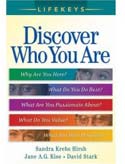
LifeKeys: Discover Who You Are

Sandra Hirsch and Jane Kise have developed an introduction to MBTI ®Personality Types that is integrated with a spiritual message and applications especially relevant to the Christian and faith-based Communities. [More Info Here on ordering this and other books on Personality Type]
* While sometimes referred to as the MBTI Personality Test, Myers-Briggs Personality Test, the Briggs Myers personality test, Myers Briggs Test or the MBTI test, the MBTI ® is not a personality test but a personality inventory or instrument in which there are no right or wrong answers.
Go Here for Workshops, Conferences & Other Resources for Coaches, Counselors and Organizational Development Practitioners interested in the MBTI, Myers-Briggs Applications, and psychological type.
Go Here for a directory of Coaches, Counselors and Organizational Development Practitioners certified to use the MBTI, Myers-Briggs Applications, and psychological type.
® MBTI, Myers-Briggs, Meyers Briggs, and Myers-Briggs Type Indicator are registered trademarks or trademarks of the Myers-Briggs Type Indicator Trust in the United States and other countries (aka meyer briggs or myers briggs).
The Cognitive Style Inventory is NOT the (MBTI) Myers-Briggs Type Indicator. The exclusive publisher of the MBTI is CPP, Inc., a publishing conglomerate who authorizes and certifies professionals in the use of this instrument. The MBTI is not a Personality Test; it is an assessment instrument. Information on its use can be obtained at the website of the Myers & Briggs Foundation. Myers-Briggs Type Indicator, Myers Briggs, MBTI, the MBTI logo, Step I, Step II and Step III are trademarks or registered trademarks of the MBTI Trust, Inc.

Return to MBTI & Myers Briggs Personality Types Home Page
 Most Popular Articles
About the MBTI - An Introduction to Myers-Briggs Personality Type.
Myers Briggs Test - What is your Personality Type?
Profiles of the 16 Myers-Briggs Personality Types.
Verifying your Myers-Briggs Personality Type.
Myers-Briggs Mental Processes - What's Your "Super-Power"?
Type Dynamics: Interpreting the MBTI ® Personality Type Code
Emotional Intelligence and Personality Type
Author Lenore Thomson on Questions, Quandries, and Queries about Personality Type
MBTI BOOKSHELF - our recommended books and booklets on Myers-Briggs personality type
Diving Deeper into
"What's My Type?"
Book Review: "The Parasitic Mind: How Infectious Ideas are Killing Common Sense" - The Civil War between Feeling and Thinking?

The MBTI Personality Type of Donald Trump - looking behind the media mask of The Donald.
New Article: Changing Donald Trump's Personality? Impossible Dream?
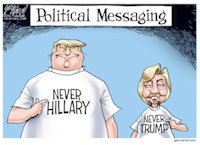
Leadership Style - Trump vs. Hillary - comparing their contrasting styles and temperament.
Finding your "True" Myers Briggs Personality Type.
Hidden Letters of Personality Type.
Learning about the Dynamics of Myers Briggs Personality Types.
Practical Business and Organizational Applications of Myers-Briggs & the MBTI.
Job Search, Career Planning & the MBTI.
Lenore Thomson on Carl Jung & Personality Type.
The Faces of Personality Type Development.
Personality Types & Emotional Intelligence.
MBTI ®Educational Applications:
Are They Really Problem Students?
 Personality Journal Articles
High Tec Gender Gap & Personality Type
Former Google employee James Damore raised the question of gender differences explaining the difficulty of high tech employers like Google obtaining proportional representation of women in high tech jobs. What does the data on Personality Type offer for this dilemma.
Lindsay Shepherd - Diversity in Academia & Personality Type
Teaching Assistant Lindsay Shepherd's confrontation with University speech police and the possible role of personality type in creating the university environment.
|

Recommended Books
on Personality Type

"I'm Not Crazy, I'm Just Not You: The Real Meaning of the Sixteen Personality Types
While not strictly an introductory book, it is an easy read for the lay person with an interest in learning about Personality Types and applying it to every day situations at home or work. Roger Pearman is one of the giants in the field of teaching practical applications of the MBTI & Myer's Personality Type. [More Info Here on ordering this and other books on Personality Type]
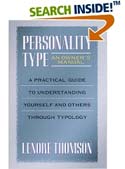
"Personality Type: An Owner's Manual" by Lenore Thomson

A layman's guide to understanding Personality Types and the theory of Psychological Types originally proposed by C. G. Jung. Lenore Thomson was formerly the former editor of the Jungian Journal Quadrant and a lecturer with the C.G. Jung Foundation in New York City. [More Info Here on ordering this and other books on Personality Type]

The 16 Personality Types, Descriptions for Self-Discovery.
I like this booklet by Nardi and Berens. About 50 pages, reasonable price, and an easy read for the person wishing to better understand his or her personality type . . . and the overall concepts surrounding Personality Types. [More Info Here on ordering this and other books on Personality Type]

Do What You Are: Discover the Perfect Career for You Through the Secrets of Personality Type

Very popular and durable career book by Paul and Barbara Barron Tieger. It has been updated for newly emerging careers. Useful for self-study or as an aid to career counseling professionals.
[More Info Here on ordering this and other books on Careers & Personality Type]

Type Talk at Work (Revised): How the 16 Personality Types Determine Your Success on the Job

"Written by noted consultant Kroeger and his colleagues, this entertaining and informative volume is aimed at anyone trying to navigate the challenging social setting of the workplace. The Myers-Briggs Type Indicator (MBTI) on which it is based was originally developed by Katherine Briggs and Isabel Myers Briggs, who drew on the work of Swiss psychologist Carl Jung. . . " Library Journal

Quiet: The Power of Introverts in a World That Can't Stop Talking

"While American culture and business tend to be dominated by extroverts, business consultant Cain explores and champions the one-third to one-half of the population who are introverts. . . Yet the American school and workplace make it difficult for those who draw strength from solitary musing by over-emphasizing teamwork and what she calls "the new Groupthink. . . " Library Journal
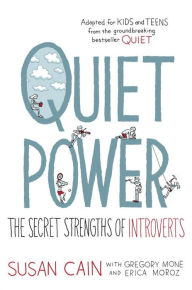
Quiet Power: Secret Strengths of Introverts
For Kids & Teens

© Published by Ross Reinhold & Reinhold Development 1997 - 2023
Privacy Policy About Us